Nature’s Notes — Spiralling into August at Maes Mynan Holiday Park
As we continue our monthly nature journals at Maes Mynan Holiday Park, we discover new treasures to share with our holiday homeowners, so they too can enjoy the marvels of our woodland and parkland paths as they take their daily walks.
This month we continue looking at nature’s patterns in a changing season as a follow on from July’s Natures Notes from Maes Mynan Park.
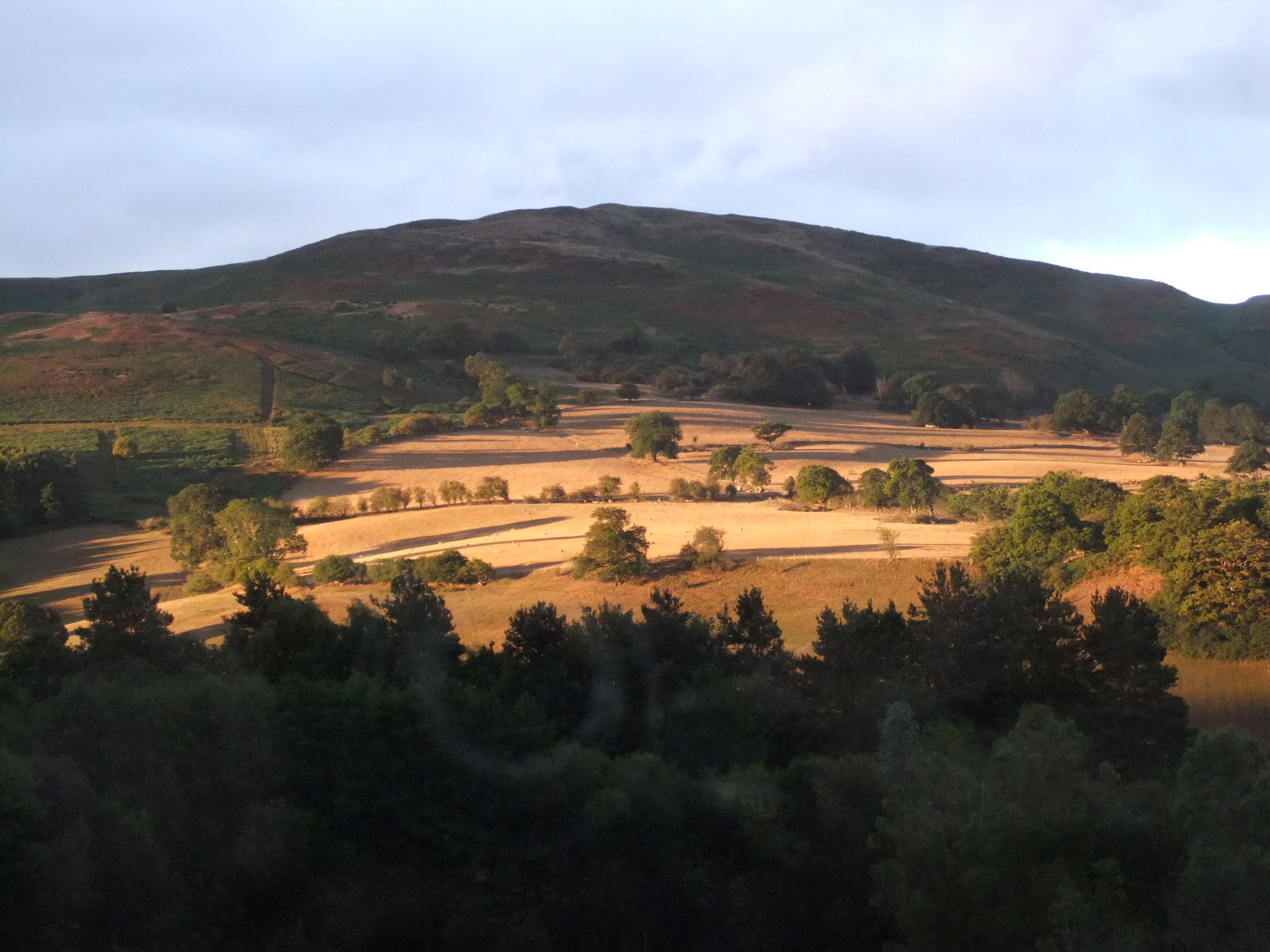
Maes Mynan Park sits within the Clwydian Range National Landscape in North Wales — a place where holiday homes open straight onto perfect countryside vistas, woodland paths, lakes and quiet parkland.
Between Summer and Autumn in the North Wales Countryside
It’s mid-August, the rains have arrived, and it feels like autumn is marching on. After the extraordinary heat and prolonged dry weather of summer, autumn seems to be edging into the landscape early. There are leaves already turning gold and russet, but this is probably a mixture of heat shock and the early seasons changes. Many of the plants that filled the woodland edges with flowers only a few weeks ago are now turning their attention to fruit and seed. And yet summer hasn’t gone.
When it’s warm, the fields still hum with crickets. Buddleia remains alive with visiting insects and butterflies. Sunflowers blaze their yellow smiles, and swallows and house martins continue to sweep through the skies. It feels as though we are holding two seasons at once.
Perhaps seasons don’t really change according to the dates we give them. There isn’t a particular morning when summer simply ends and autumn begins. Instead, for a while, they overlap; one quietly making way as the other begins to arrive.
And this August, that transition has made me look at the landscape rather differently. Rather than setting out to discover what was new, I found myself looking more closely at what was already there. And once I did, I began to notice patterns.
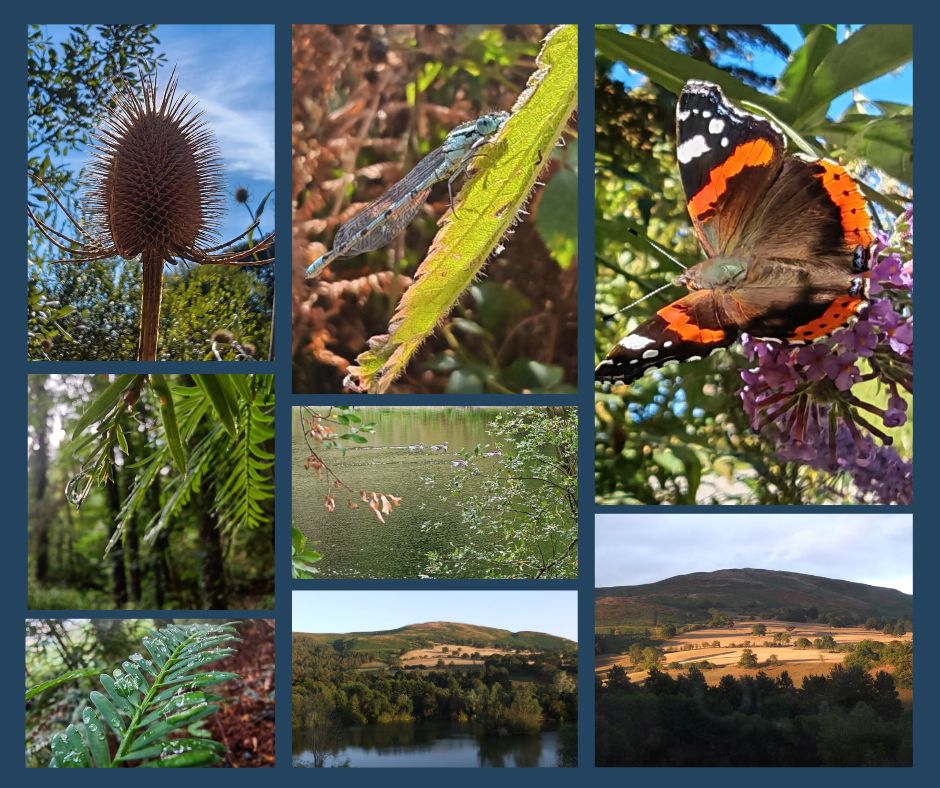
Spiralling into August — Patterns in Nature
There are patterns in nature that I know to look for, and others that seem to appear only when I slow down enough to notice them. Walking through the woods at Maes Mynan Park this August, I began seeing spirals everywhere.
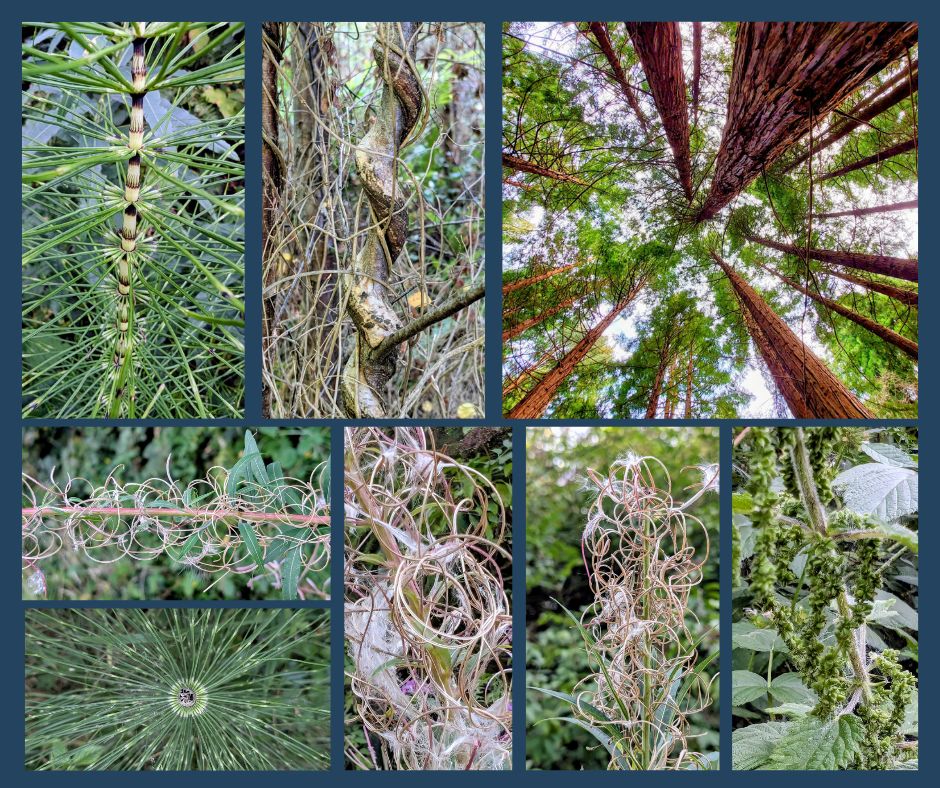
Rosebay willowherb was the first to catch my eye. Its tall pink flower spikes, which only weeks ago brought such wonderful colour to our woodland paths, are now giving way to long seed pods. As those pods ripen and split, something rather beautiful happens. Their sides peel backwards into delicate curls and twists, releasing clouds of silky white seed into the air. Each tiny seed is perfectly equipped to be caught by the wind and carried onwards to start its new journey elsewhere. These were my first August spirals — spirals made by opening, not closing. Once I’d seen one, I began seeing them everywhere.
Nature Doesn’t Appear to Have Read the Geometry Textbook
Nearby, the hanging flowers and seeds of the nettles suddenly seemed patterned, too. I must have walked past them hundreds of times without really looking, yet their tiny fruit clusters hang beneath the leaves in beautifully ordered, catkin-like tassels.
Then there was the artistry of honeysuckle. Its woody stems have twisted tightly around young silver birch trees, climbing towards the light, creating a carving, a sculpture, and something of beauty in the bark of the tree. The honeysuckle plant had combined with the silver birch to create a thing of beauty that one day will make a perfect rustic walking stick. This is rather fitting for a tree that has accompanied our countryside wanderers I think.
Elsewhere, alder cones reveal another pattern. Pick one up and what initially appears to be a jumble of tiny woody scales begins to resolve into order. Turn it slowly, and lines seem to wind around its central axis.
Rosebay willowherb curls as its pods open. Honeysuckle spirals as it grows. Alder hides spirals within its structure. Each creates a similar pattern for an entirely different reason. Of course, not everything is a perfect mathematical spiral. Some are curls, some coils, some whorls and some radiating forms.
Perhaps that is what makes searching for patterns in nature so absorbing.
A Spiral You Have to Catch in the Act
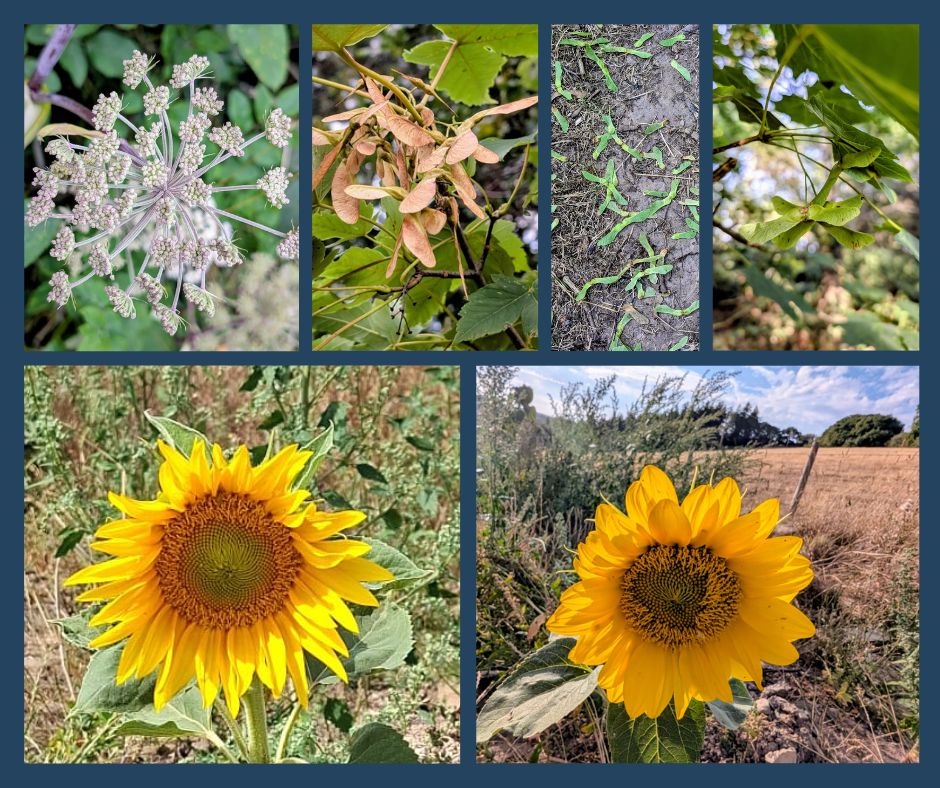
Beneath the maples, the woodland paths are scattered with winged seeds. Looking upwards, there are more hanging in clusters beneath the leaves. But between those two moments — hanging from the tree and eventually lying at our feet — something remarkable happens. Released into the air, the winged maple fruit begins to auto-rotate, spinning like a tiny helicopter and slowing its journey towards the ground. Here, the spiral isn’t something we can pick up or photograph easily. The spiral exists in movement: a pathway drawn briefly through the air. Suddenly, the seeds scattered across the woodland path aren’t simply something that has fallen from a tree. They are evidence of hundreds of tiny little flights.
Sometimes the Pattern Depends Upon Where You Stand
Searching for patterns in nature eventually made me look upwards. Standing beneath the magnificent sequoias changes your perspective completely. From a distance, we notice their immense height and reddish-brown trunks, but stand beneath their canopy and look upwards towards the sky and another architecture appears. Branches radiate around the trunk like spokes, repeating as your eyes travel upwards. Even the bare branchlets awaiting their eventual fall become part of the geometry.
Mare’s-tail, or horsetail, creates another extraordinary radial pattern much closer to the ground, its fine branches spreading from the central stem like miniature green fireworks.
Once You Look for One Pattern, You Begin to See Others
But not everything I found was a spiral. Once my eyes became accustomed to searching for patterns, other geometries began appearing too. Stars. Spokes. Circles. Branching forms. Old umbellifer seed heads resemble tiny constellations, one burst dividing into smaller bursts and repeating the same form again and again. Seed heads become circles; leaves reveal intricate networks of veins; and ferns repeat themselves on ever smaller scales. There is order everywhere, but rarely absolute perfection. Perhaps that is one of nature’s greatest design lessons: beauty doesn’t require uniformity.
Summer Still Has Something to Say
For all these signs of transition, August certainly hasn’t surrendered to autumn.
In the rough, disturbed ground of our touring caravan park, currently under construction, sunflowers have appeared. Not carefully positioned in a flower bed or planted for effect, but simply pushing their way through the disturbed earth. No doubt the summer heat playing its part.
One has produced an almost perfect golden flower, its centre packed with hundreds of tiny florets arranged in intersecting spirals, offering another remarkable example of nature creating mathematical-looking order without anyone drawing the plan.
Nearby, the buddleia is still attracting visitors, and from the dry grasses comes another unmistakable sound of high summer: the rhythmic calling of crickets.
The leaves may be turning golden, but summer is still here.
An Unexpected Visitor to the Buddleia
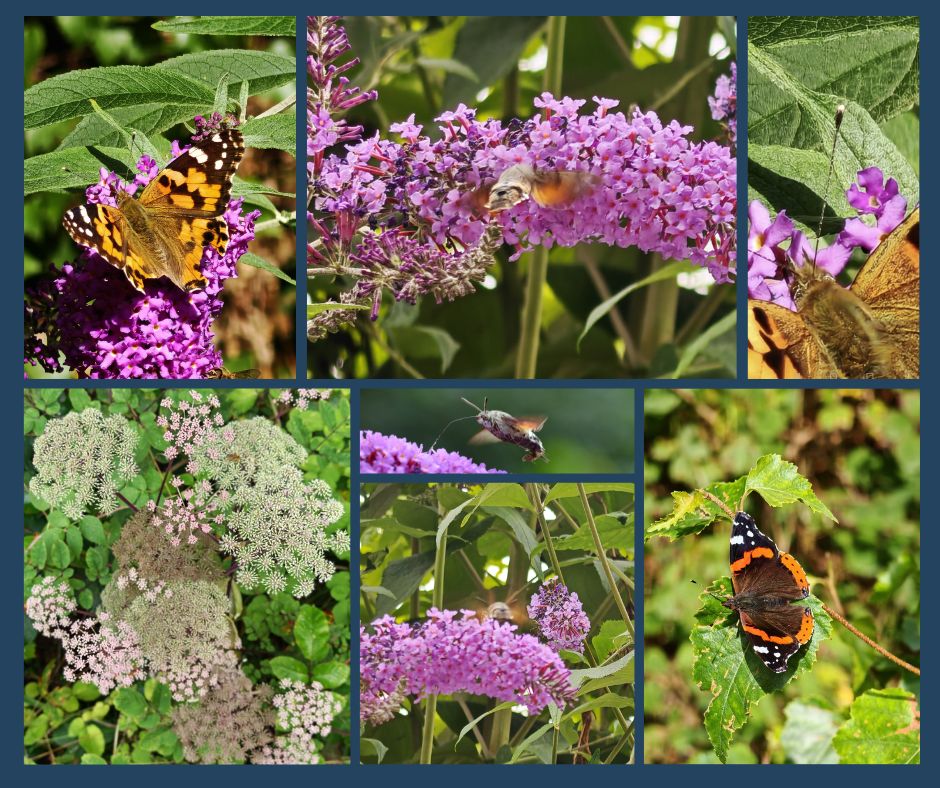
One particularly exciting August discovery came courtesy of WH, one of our holiday homeowners, who spotted a Hummingbird Hawk-moth feeding among the purple buddleia during one of his walks around Maes Mynan Park.
If you’ve never encountered one before, it is quite a sight. This remarkable day-flying moth hovers almost motionless in front of a flower while feeding through an extraordinarily long proboscis, before darting rapidly to the next bloom. Its wings beat so quickly that they become little more than a blur and produce the characteristic hum that, together with its hovering flight, gives the moth its wonderfully appropriate name.
The Hummingbird Hawk-moth (Macroglossum stellatarum) is a summer migrant to Britain, travelling north from southern Europe and appearing here in varying numbers each year. Although sightings are more frequent in southern Britain, these remarkable travellers can turn up across Wales too — making finding one busily feeding on our buddleia a particularly memorable moment on an ordinary summer walk.
With a wingspan of around 5–6cm, they are powerful fliers, and flowers rich in nectar provide important refuelling stops. Buddleia clearly provided exactly what this particular traveller was looking for.
And perhaps that’s another reason to keep looking closely at the familiar. WH could quite easily have walked past that buddleia and seen simply another beautiful summer shrub. Instead, he stopped, noticed — and discovered that a tiny visitor from continental Europe had arrived at Maes Mynan Park.
From the Hedgerow – August’s Wild Harvest
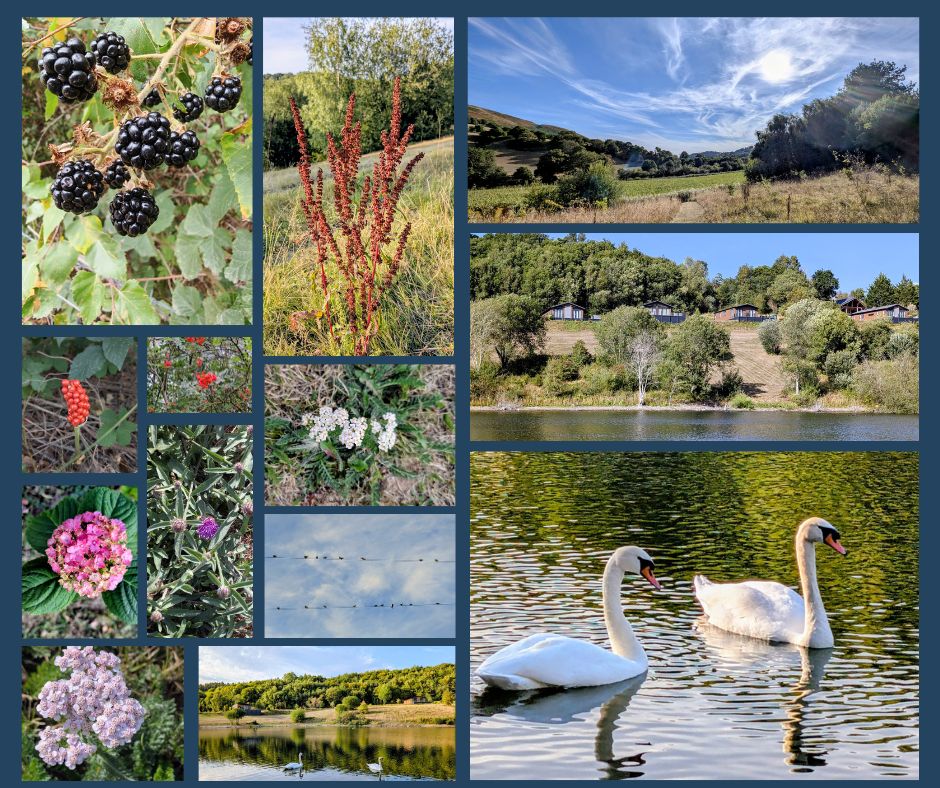
August brings another pleasure to our countryside walks — the beginning of the hedgerow harvest. Blackberries are ripening along the paths at Maes Mynan Park, some irresistible enough to eat as you walk, still warm from the summer sun. Pick them while you can because prolonged rain can quickly soften the fruit and bring the best of the blackberry season to an end. Better still, take a handful home and pair them with early apples for that wonderfully traditional taste of the British countryside: a blackberry and apple pie or crumble, preferably served warm with custard or cream!
Our rowan trees have surprised us too. Despite the extraordinary heat, some have produced beautiful clusters of berries, bringing flashes of orange and scarlet to the landscape.
The rowan has been surrounded by folklore for centuries. Sometimes called the Mountain Ash, although it isn’t actually an ash tree, it was traditionally regarded as a protective tree. In British and particularly Scottish folklore, rowan was planted near houses and carried by travellers as protection against witchcraft and misfortune. Its berries even carry a tiny five-pointed star at their base — something that helped strengthen its reputation as a magical and protective tree.
There is also a practical tradition worth rediscovering: rowan jelly. Rowan berries are very bitter eaten raw, but cooked with apples and sugar they make a beautifully coloured, sharp-sweet jelly traditionally served with game, lamb, cheese or cold meats.
A simple country version begins with roughly equal quantities of rowan berries and chopped cooking apples. Cover them with water and simmer gently until the fruit is completely soft. Tip everything into a jelly bag and allow the juice to drip through — resist squeezing it if you want a beautifully clear jelly. Measure the resulting juice, add approximately 450g of sugar for every 600ml of juice, then boil until setting point is reached. Pour into hot sterilised jars and seal.
One old country tradition says rowan berries are best gathered after the first frost, when the cold helps soften their bitterness. These days, popping freshly picked berries into the freezer overnight can imitate the same effect.
So perhaps August’s patterns aren’t confined to spirals after all. There is another ancient cycle unfolding around us: flower to fruit, fruit to harvest, harvest to kitchen, with the countryside quietly providing its seasonal bounty once again.
One small safety point worth noting about Rowan berries: rowan berries shouldn’t be eaten raw; cooking is their traditional preparation and, as with all foraging, only pick fruit you can confidently identify and from places where you have permission.
August’s Changing Colours
Some of August’s colours seem almost impossibly bright against the dusty greens and early browns.
On the woodland floor, the Lords-and-Ladies that flowered quietly beneath the trees in spring are almost unrecognisable. Their unusual hooded flowers have disappeared, and in their place stand stems crowded with glossy orange-red berries. They are strikingly beautiful in the shade, but very definitely for admiring rather than eating as the plant, including its berries, is poisonous.
Nearby, the hydrangeas tell their own story of the changing season. Some heads remain delicately pink, while others are beginning to fade, their showy outer flowers paling as the intricate centres mature. Within a single flower head, summer and what comes next seem to sit side by side.
Sorrel has changed too. Its lighter summer flowers have given way to tall rust-coloured seed heads, glowing almost copper when they catch the evening light.
And so Mother Nature continues her magic: Flower becomes fruit, fruit becomes seed, green begins to turn gold and the landscape prepares for what comes next.
Wings Above the Park
The wildlife around Maes Mynan is changing with the season, too.
A charm of goldfinches darts among the purple thistles, drawn to the seeds that are beginning to replace summer’s flowers.
Swallows and house martins are increasingly gathering together, sometimes lining the wires against the August sky before lifting away to feed once more. They may remain with us for a little while yet, but instinct is beginning to prepare them for the immense journey south that lies ahead.
Down by the lakes, this year’s Greylag and Canada Goose youngsters hardly look like goslings any more. The soft, downy youngsters we watched earlier in the summer are taking on their adult plumage, growing into their wings and moving gradually towards independence.
Everywhere, it seems, the young are growing up and the season is moving onwards. We were also graced with the presence of a pair of swans for a couple of days last week. I love the fact we were their ‘hotel’ for the weekend.
A Thought from Maes Mynan Park for August
Perhaps this month’s Nature’s Note isn’t really about spirals at all. It’s about looking.
When the season appears tired, when flowers are fading and an unusually dry summer has brought hints of autumn prematurely into the woods, fields and along the paths, it would be easy to think there is less to see.
Look more closely and the opposite becomes true.
- A Rosebay willowherb pod curls open, a sign that summer is passing.
- A maple seed spins towards the ground early this year.
- Honeysuckle records years of growth around the trunk of a tree to create something of natural beauty.
- A fading seed head becomes a tiny constellation.
- A sunflower pushes unexpectedly through disturbed ground.
- Young geese grow into their wings.
- House martins and our few swallows begin preparing for a journey written into their instincts long before we understood it.
So we’ve decided that nothing has stopped happening, it’s just the landscape simply changing its language.
The Quiet Privilege of Returning — Holiday Homeownership at Maes Mynan Park
Perhaps one of the greatest pleasures of owning a holiday home in the countryside is not simply having somewhere beautiful to escape to, but having somewhere you can return to often enough to really get to know it.
At Maes Mynan Park, every visit reveals something slightly different. You begin to remember where the first wild garlic appeared in spring, notice when the goslings lose their down, recognise when the rosebay willowherb begins releasing its seed and perhaps even stop beneath a maple to watch one tiny winged seed spiral towards the ground.
Over time, these small observations become part of knowing a place, which is something rather different from simply visiting the countryside for a few days.
Holiday homeownership at Maes Mynan Park offers the opportunity to return throughout the seasons, to walk familiar woodland paths, watch the lakes change, discover the wildlife that shares this landscape and experience the quieter rhythms of rural North Wales in a quiet and beautiful way.
For those searching for holiday homes for sale in North Wales, perhaps that is worth considering. A holiday home is somewhere to stay, yes, but more importantly, it’s where you find your peace. That makes choosing the right location everything.
Here at Maes Mynan Park, our holiday homes sit within a country estate of parkland, woodland, lakes, meadows and walking paths, surrounded by the landscape of the beautiful and the imposing Clwydian Range. It is a place where stepping outside your holiday home can be the beginning of the day’s adventure, even when that adventure is simply taking the same favourite walk and discovering that nature has changed it again.
This August, summer is still humming among the buddleia and singing from the grasses, while autumn has already begun curling open seed pods, scattering winged seeds across our woodland paths and adding its first touches of gold to the trees.
Next month, it will be different again.
And perhaps that is the real privilege of having your own countryside retreat at Maes Mynan Park. You don’t have to experience it just once, you can keep coming back.
Holiday homes at Maes Mynan Holiday Park start from around £60,000 for static caravans, rising to £300,000 for luxury lodges. All owners share access to the estate’s woodland, lakes and walking paths.
Photos from WH, DL & LB.
Thank you, too for this month’s inspiration via photos and observations for our Nature’s Notes series of posts.
acornleisure.com | 01352720808 | info@nullacorneleisure.com | Where are we?