As autumn arrives at Maes Mynan Park, nature seems to know exactly what comes next.
September arrived with rain.
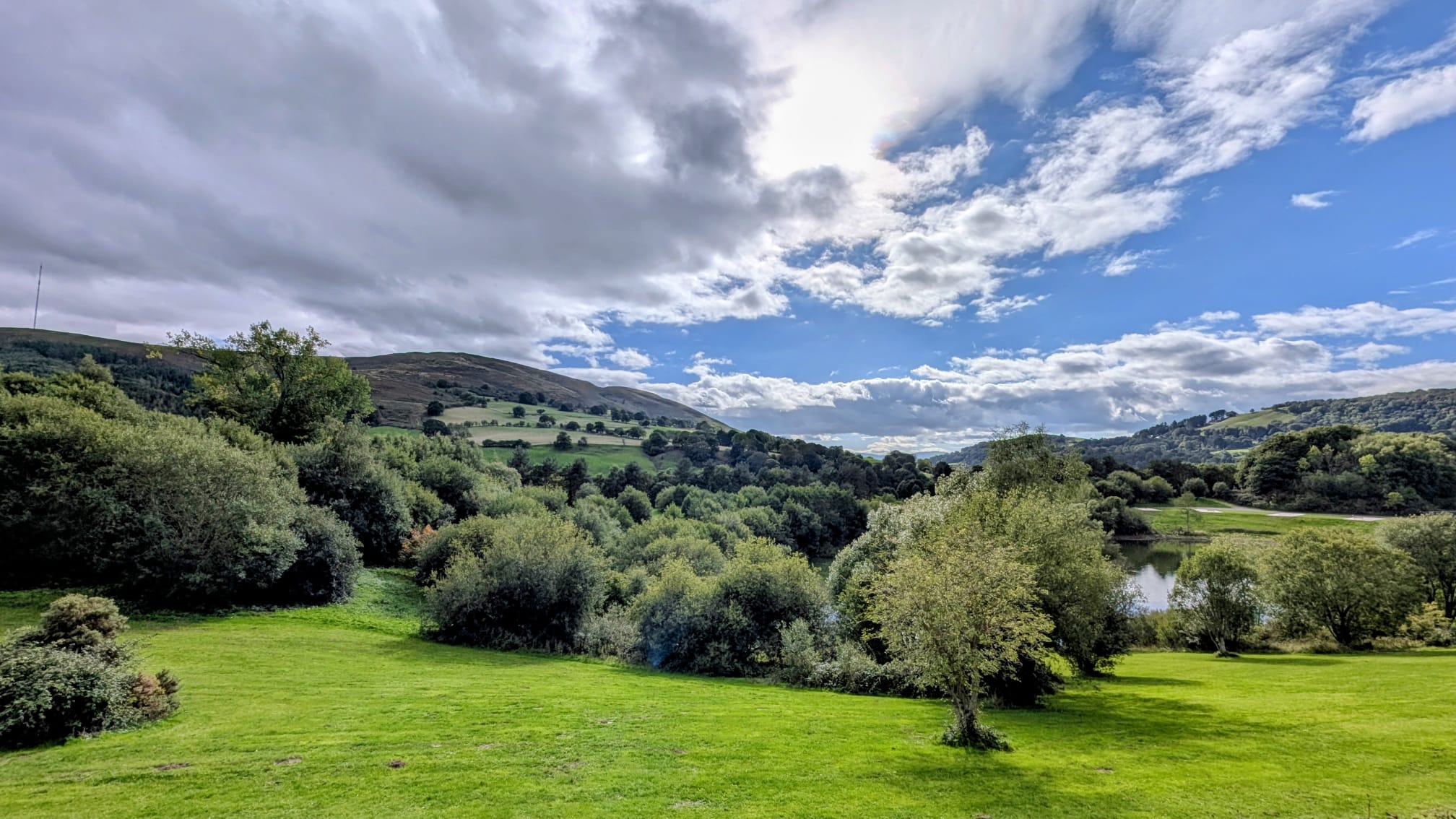
After the long, extraordinarily dry summer, within little more than a week the North Wales landscape at Maes Mynan Park seemed transformed. Grass that had spent weeks dressed in gold and dusty brown was suddenly green again, all lush, soft and growing. A true sign that Mother Nature hasn’t given up, she’s simply been waiting for rain.
As quickly as the grass responded, so did the wildlife. Young rabbits have begun venturing out to graze again, something particularly lovely to see after they have been woefully absent around the Park over the past couple of years. Watching them nibbling at the new green growth feels like another small sign of recovery, which leads us on to nature’s first September lesson – sometimes what appears to have disappeared is simply waiting for the right conditions to return.
Squirrel Nutkin and the Instinct to Gather
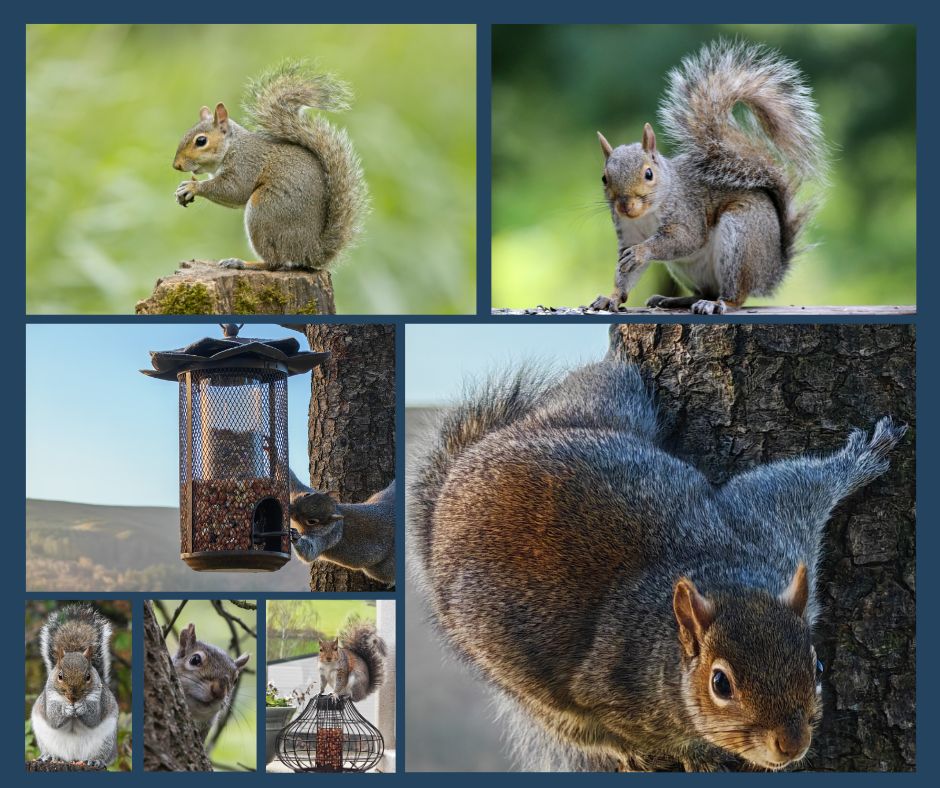
Almost on cue, another September character has joined our afternoons. We’ve named him Squirrel Nutkin, even though he’s not a red squirrel. He’s a young grey squirrel who regularly dashes past the office doors at Maes Mynan Park with his latest prize held proudly in his mouth. Strangely, he seems to keep to a schedule with afternoon, apparently, his gathering time.
September is an important month for squirrels. Nuts, seeds and acorns provide energy-rich food, and rather than creating one enormous winter store, grey squirrels practise something called scatter-hoarding, hiding food in numerous individual caches to retrieve later. Not every hiding place will be remembered, but this provides one of those lovely accidental relationships in nature, where a forgotten nut or acorn will germinate into a wonderful new tree.
Can we rely on Squirrels to predict the Winter?
There is an old belief that squirrels gathering particularly frantically in autumn are warning us of a severe winter ahead.
It’s an appealing piece of country folklore, but not a reliable weather forecast.
Squirrels gather food in autumn because seasonal change tells them it is time to prepare, rather than because they possess some mysterious knowledge of exactly what January’s weather will bring. Nevertheless, there is something fascinating about watching instinct at work. We consult forecasts and weather models. Squirrel Nutkin simply gets on with gathering. Perhaps reading the signs of nature is a squirrel’s prerogative.
An Empty Nest and a Changing Season
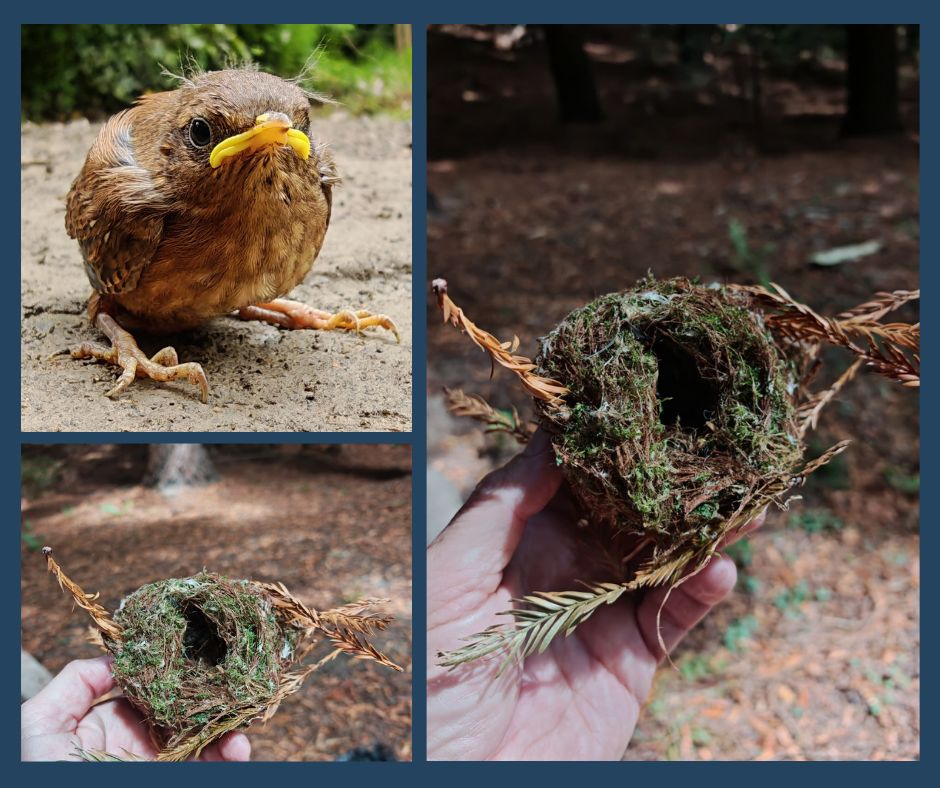
WH, one of our holiday homeowners and a regular contributor to our Nature’s Notes, has made another lovely discovery. Within the Acorn & Giants event space, he found a beautifully formed wren’s nest. We loved this because we’ve called our new waterside lodge The Wren Retreat, as a nod to the little wren who hops around the shrubs, again, outside the Maes Mynan Park office!
Earlier in the year, so many of our observations centred around beginnings — nests being built, eggs, goslings, young birds and new life appearing throughout the park. An empty nest in September tells a rather different story. There is something quite touching about something that was once the centre of such activity becoming quiet again. Its purpose fulfilled, the little structure remains as evidence of everything that happened there during spring and summer. It’s a reminder that we’re moving away from the season of offspring, flitting and flirting, towards something quieter as nature shifts towards autumn.
The Secret Lives of Our Hares
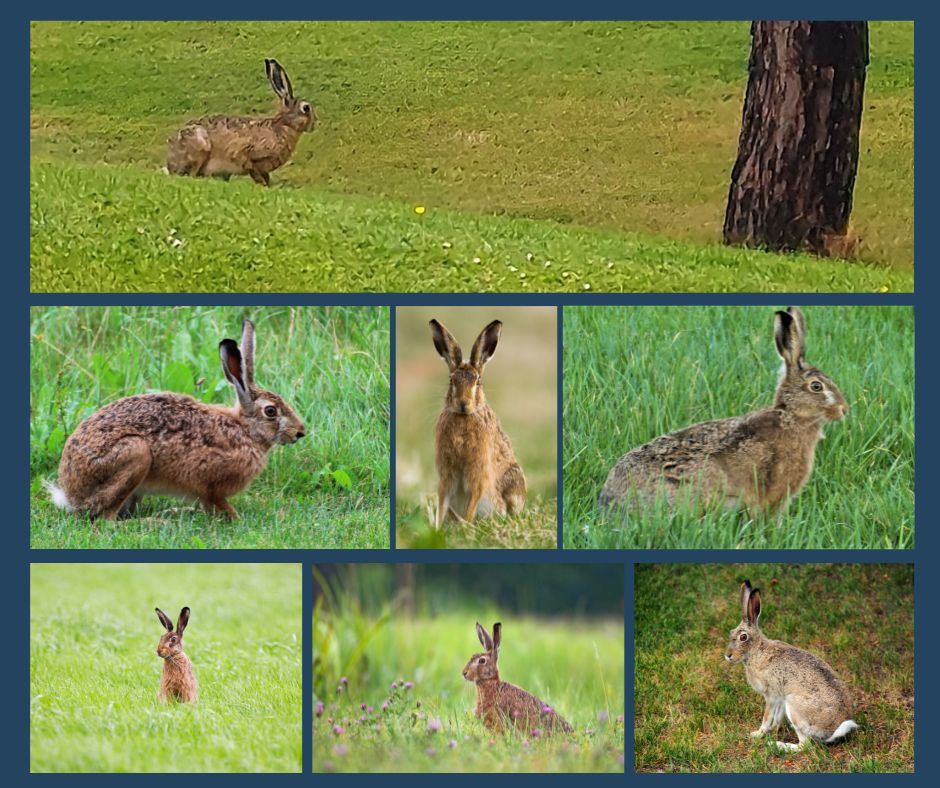
Our family of brown hares can still be glimpsed among the field grasses. Occasionally, they scamper away, but at other times you need to look remarkably carefully to find them. Unlike rabbits, brown hares don’t usually disappear underground into burrows. Instead, they rest above ground in shallow depressions called forms, often tucked among vegetation where their colouring provides extraordinary camouflage. So those sandy hollows we’ve noticed among our fields aren’t elaborate homes at all. They are protective hollows, chosen as their place to be still and settled for rest, but also a home with a vantage point where they can observe and heed approaching danger.
As autumn advances, good feeding areas and sheltered places become increasingly important to our hares, so we may see them move to the woodland edges and hedgerow undergrowth for additional cover during harsher weather.
We love our hares. Their nocturnal habits and extraordinary speed are associated with the moon, transformation and the supernatural in folklore. Those stories tell of witches taking the form of hares, while in other traditions they become associated with fertility and renewal. Watching our hares disappear almost magically into the grasses remind us why these stories began.
Footprints Beside the Stream
We don’t always have to see an animal to know it has visited.
After September’s rain softened the ground beside our streams, the deer began leaving their calling cards again — delicate hoof prints pressed into the mud. September is an interesting transitional month in the deer calendar, so even when the deer themselves remain hidden among the trees, the ground beneath our feet tell us they’re here.
Hunters by Day, Hunters by Night
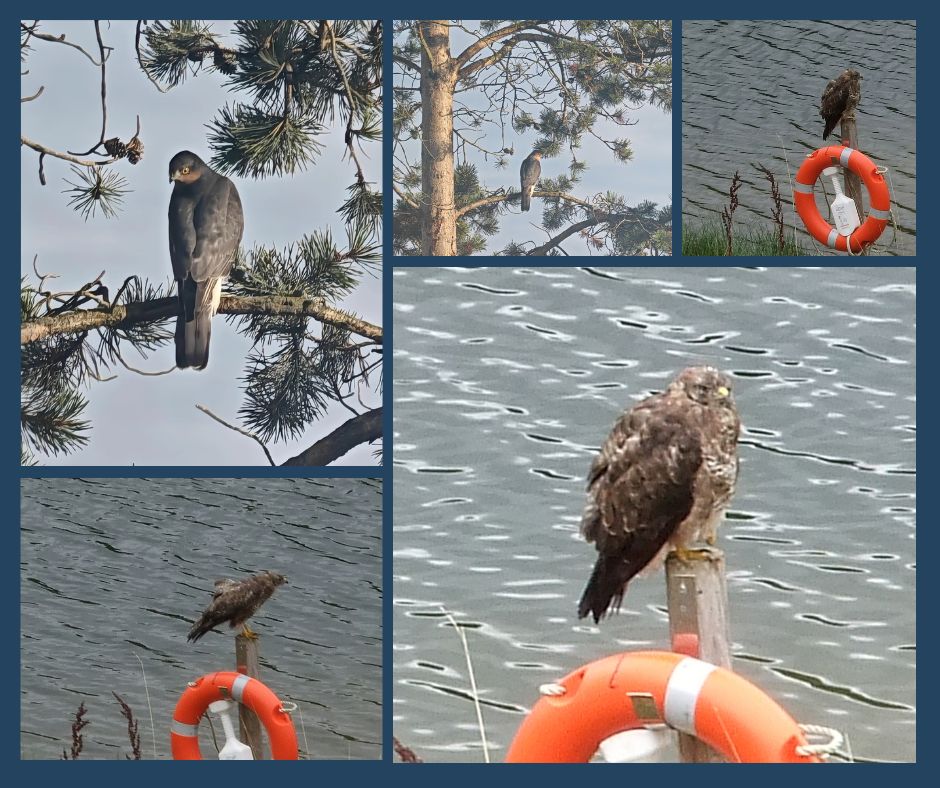
Our resident buzzard has become increasingly prominent too. We often find it sitting almost statuesque on posts, surveying the surrounding ground for potential prey. It has even taken to perching close to the water’s edge, quietly watching the landscape below. But as daylight retreats, another hunter takes over.
The nights are closing in remarkably quickly now and, with the darkness, the calls of our owls seem nearer and clearer among their favourite trees. There is something particularly atmospheric about hearing an owl when you’re tucked away in the countryside. First silence. Then a call from somewhere in the trees. Another answers. For a few moments, a conversation is taking place in the darkness that has absolutely nothing to do with us.
But we also have another visitor too. A Sparrow Hawk. He’s been photographed by WH outside his holiday home high in the pine trees, noticed because there was an absence of all the little birds on the feeders outside the window of his holiday home.
A Quiet Victory for the Pheasants
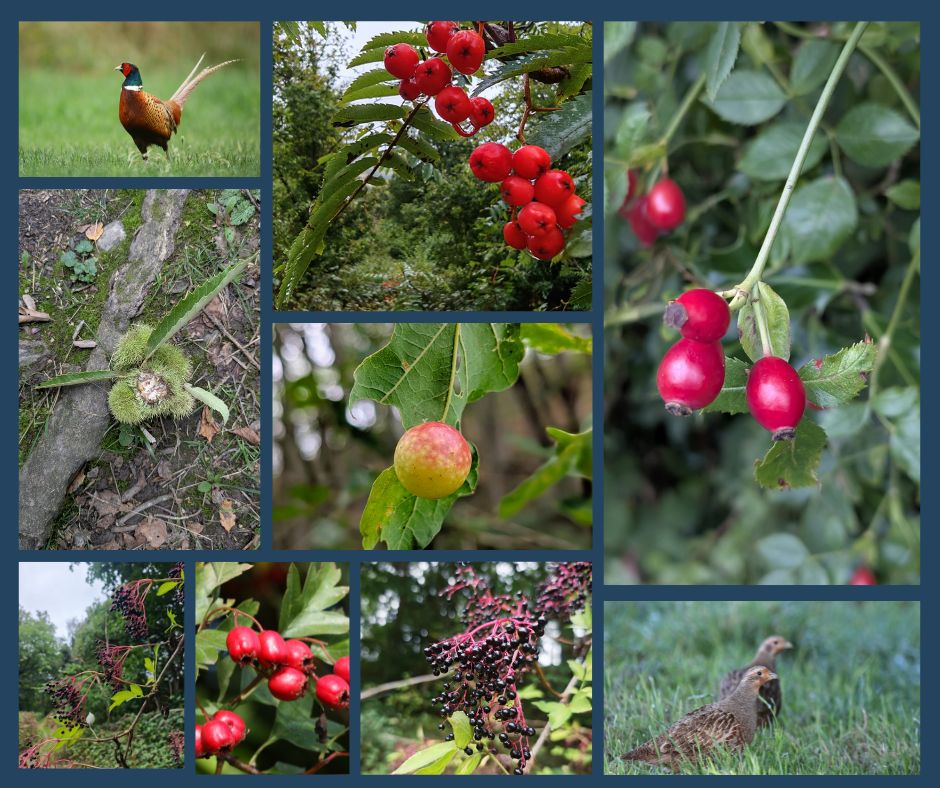
The young pheasants we’ve watched growing throughout summer are becoming increasingly independent too, scampering through the undergrowth and disappearing rapidly whenever they’re disturbed. There is something particularly satisfying watching the pheasant and partridge families who have chosen Maes Mynan as their home, especially as autumn can bring different challenges for these birds. For now, they have found their places among the grasses, woodland edges and undergrowth and with their survival comes one of nature’s quietest victories: an escape from the norm and the local shoot!
September’s Natural Larder at Maes Mynan Park
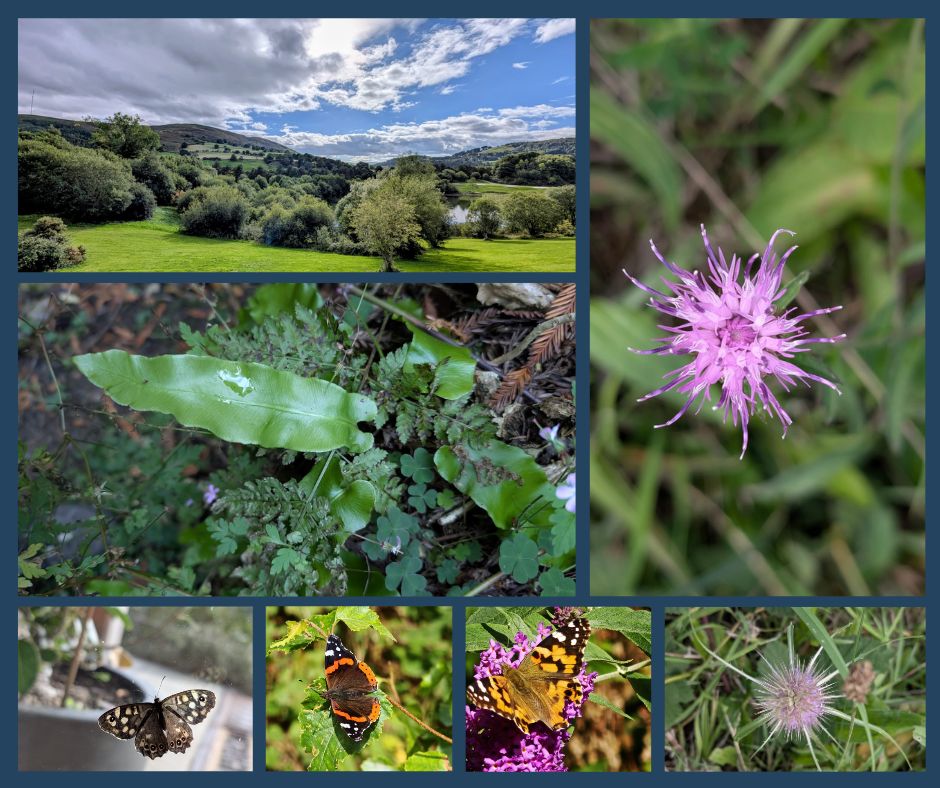
It isn’t only the animals preparing. The hedgerows have changed their colours too. Our elderberries have ripened to their familiar deep purple-black, although after such an exceptionally dry summer, there isn’t quite the abundance we’ve come to expect. The brilliant red berries of the Guelder Rose provide another splash of September colour, but they can remain on the shrub into winter to provide food for birds, while the dense shrub itself will offer valuable habitat and cover.
Elder has its own wonderful collection of old beliefs. For centuries, it was regarded as a protective tree. In folklore, planting an elder close to the home was believed to ward off evil, while its flowers and cooked berries also became part of the traditional country kitchen.
Haws, sloes and rosehips appeared early this year too, accelerated by the extraordinary summer weather, and some are already beginning to look past their best. The blackberries tell a similar story. Their season arrived early and the September rain has largely finished those that remained. After August’s pleasure of eating them straight from the hedgerow, only remnants of that particular harvest remain. Nature’s larder is constantly changing. What is abundant one week may be gone the next.
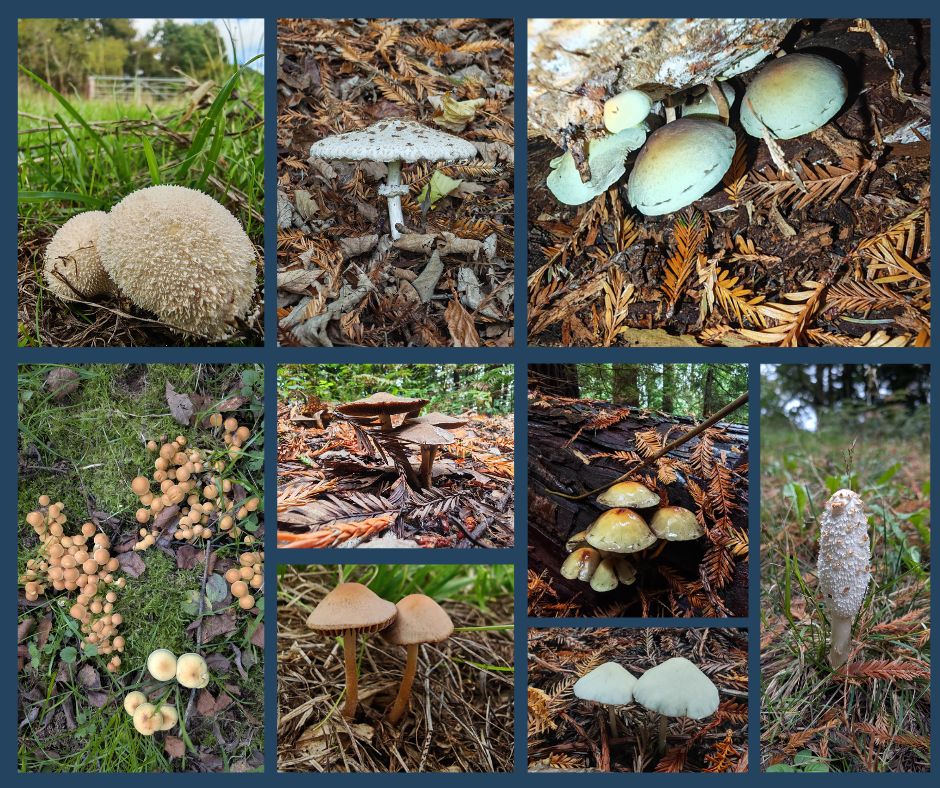
When the Woodland Wakes Beneath Our Feet at Maes Mynan Park
The September rain hasn’t only transformed the grass. Combined with lingering warmth and humid air, it seems to have awakened another hidden world across Maes Mynan Park. WH, has been discovering fungi in all shapes, colours and sizes along our woodland paths. Emerging through the leaf litter, clustered across fallen and decaying timber and, rather wonderfully, even colonising the old rope barriers beside the paths, he’s discovered overnight the fruiting body of a much larger fungal organism. The above surface toadstools and mushrooms are the produce of a vast unseen network of fine threads called mycelium that weave through the soil and dead wood beneath our feet. Fungi are some of the woodland’s great recyclers, helping to break down organic matter and return nutrients to the soil ecosystem, while many also form extraordinary relationships with living trees.
After a summer when the ground seemed almost suspended by drought, their sudden appearance feels like another piece of Mother Nature’s September magic, with rain falling, moisture returns and an entire hidden kingdom begins to revive and reveal itself once again.
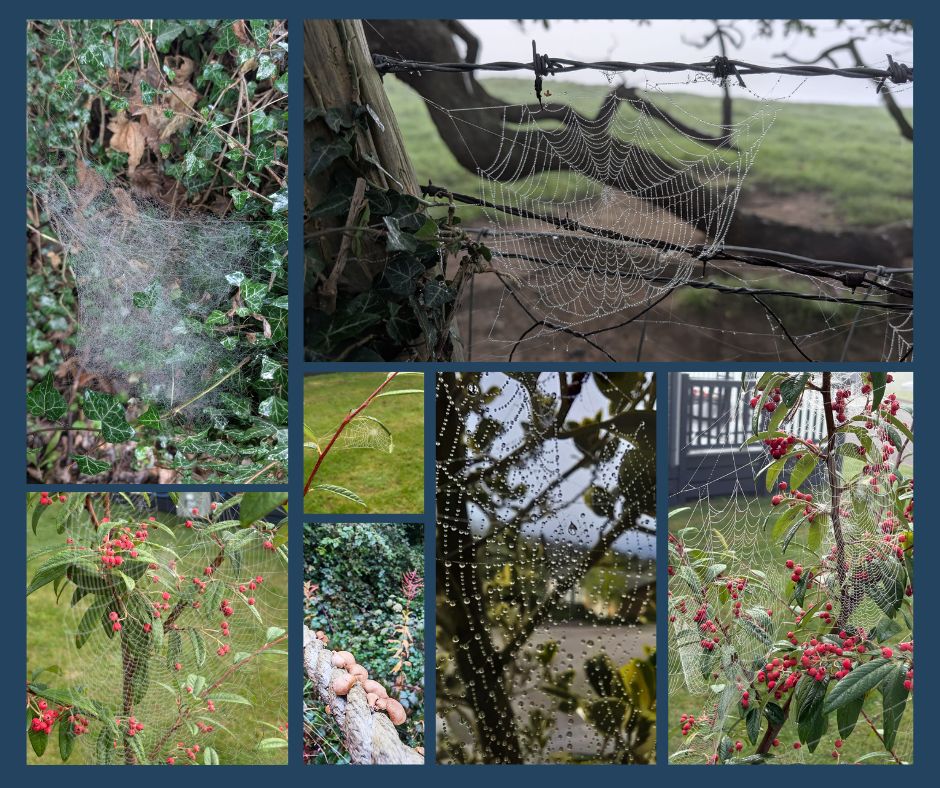
When the Invisible Becomes Visible
An early morning walk through Maes Mynan this September, saw thick fog settle low across the landscape, the cooler air trapped close to the ground beneath warmer air above. This temperature inversion created a wonderfully atmospheric morning and showed me a world that we often miss.
Walking through the fog, I became increasingly aware of the threads of silk stretching across the path. They brushed against my face as I walked, and each time I broke one I felt as though I had interrupted something.
These weren’t necessarily webs at all, but the routes that had helped the spiders reach the places where their webs would eventually be spun — nature’s tiny zip wires, spanning gaps that seem enormous when you consider the size of their maker.
Then the fog revealed the destination.
Across branches, fences and among the undergrowth were hundreds of webs. Some were great circles of almost mathematical symmetry; others disappeared into funnels or spread like sheets across the vegetation. All unique designs, built upon similar footprints.
Ordinarily much of this world of silk would have remained unseen. But every suspended droplet of fog had attached itself to a thread, tracing the spiders’ night’s work in silver-white.
Even high in the trees, where I would normally have seen only branches and leaves, there was a cloudy whiteness between them. Hundreds of webs were briefly revealed, staying as long as possible until a bird, a squirrel, or a gust of wind made them disappear again.
The fog hadn’t created the beauty. It had simply allowed us to see what had been there all along.
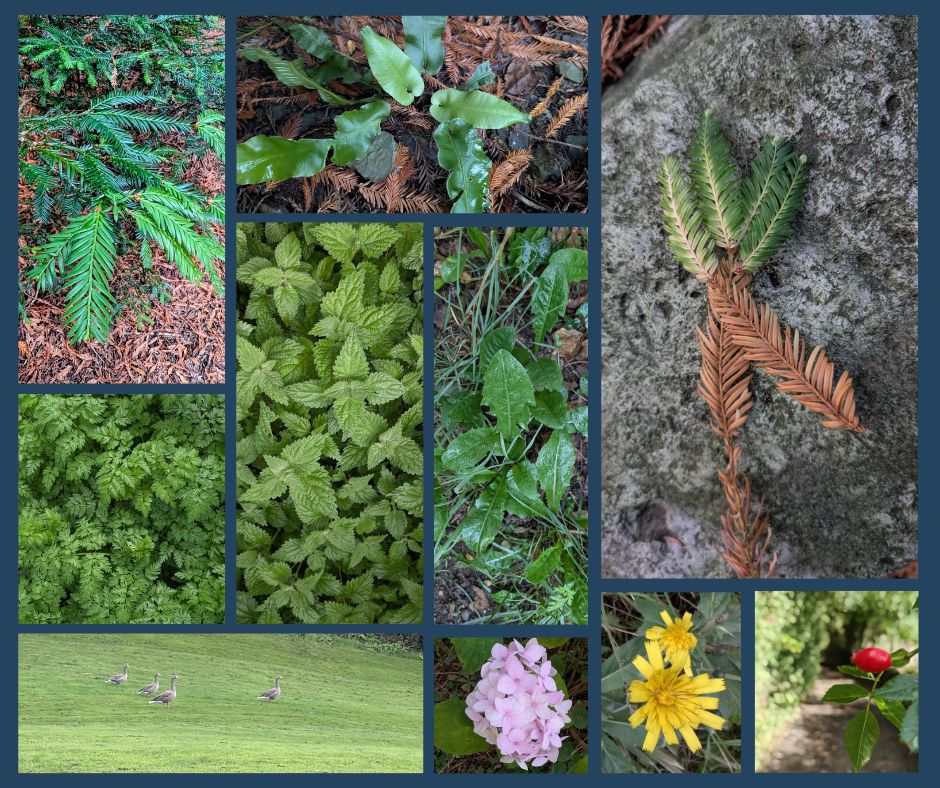
When September Begins Growing Again
Down at ground level, something equally curious is happening.
After months of dry summer weather, it seems growth was held in suspension. But with September’s rain followed by remarkably warm, humid days, we saw a spurt of growth that couldn’t be missed.
Fresh dandelion leaves are pushing through again. Nettles have found another burst of energy. Shrubs and woodland plants that seemed tired only weeks ago are producing fresh growth.
Even the sequoias appear to be responding, with fresh green tips contrasting against foliage that carries the evidence of the summer drought.
It almost feels as though the seasons have become muddled. Yet perhaps what we’re seeing isn’t nature getting the calendar wrong at all. Plants respond to their surrounding conditions — moisture, warmth, light and available nutrients — and after a prolonged period of water stress, rain followed by warmth has provided an opportunity for renewed growth. All that energy that seemed to be waiting during the drought finally had somewhere to go. Perhaps that’s the real story of September at Maes Mynan Park this year.
We began the month watching brown grass become green again. Rabbits returned to graze it. Fungi appeared from damp wood and woodland floors. Nettles and dandelions responded with fresh growth. Spiders filled the newly humid air with silk.
What looked exhausted wasn’t necessarily finished. Some of it was simply waiting for a second spring. Autumn above. Spring-like renewal below. It felt as though nature had become confused. But nature doesn’t own a calendar. Plants respond to temperature, moisture and daylight, and after months of drought stress, the return of rain while temperatures remained unusually warm created an opportunity for renewed growth. Perhaps September wasn’t confused at all. Perhaps nature was simply responding to the conditions it had been given.
Thought from Maes Mynan Park this September
We can’t ask September to wait, or hold autumn at the gate, or persuade another summer evening to linger just a little longer. However, we can enjoy the balmy temperatures and watch the birds, bees, butterflies and squirrels go about their business just a little bit longer.
We can relish the changing season, slow down and make time for the things we love.
We can find inspiration from the coming autumn, with all its subtle changes and enjoy the opportunity to retreat, recharge and reset, taking our guide from nature.
I think our best thought this month is to unwind our minds outdoors and enjoy what we see and find.
What does a holiday home give our holiday homeowners at Maes Mynan Park
For many of our holiday homeowners, Maes Mynan Park offers a countryside retreat in North Wales that becomes somewhere familiar to return to whenever they have the opportunity. A place they can call their own and where they don’t have to always plan an elaborate escape. They can arrive, close the door on the demands of everyday life and rediscover a different measure of time. That’s the pleasure of holiday homeownership at Maes Mynan Park.
For those considering a country escape to North Wales, we have a range of holiday homes for sale at Maes Mynan Park where ownership isn’t simply about having somewhere beautiful to stay. It’s about having a place of your own to return to often enough that you begin to know its seasons, recognise its wildlife and notice the small changes that someone passing through might never see.
As the colours begin to change at Maes Mynan Park, perhaps autumn is offering all of us an invitation to slow down, welcome the changing season and make time for the things that restore us.
Dreams are for making.
Nature is for noticing.
Seeing is believing.
And sometimes, making a change begins simply…one step at a time.
Are you looking for a special countryside retreat to call your own? If you are, have a look at our Holiday Homes For Sale – Luxury Lodges and Static Caravans – > Here
Photo credits and thanks to WH, WP, DL, VW & LB
acornleisure.com | info@nullacornleisure.com | 01352 720808 | Book a tour | Where We Are & Contact